


5 Myths About HOA Board Power That Need Busting

The relationship between homeowners and their Homeowners Association (HOA) Board can sometimes be filled with tension. Much of this friction stems from misunderstandings about the board's authority. Homeowners may feel that the board operates with unlimited power, while board members often struggle to communicate the legal and practical limits of their volunteer roles. Busting these common myths is essential for fostering a more collaborative and harmonious community.
This article will debunk five of the most persistent myths about HOA board power. By clarifying the board's actual role and its limitations, we can help both homeowners and board members build a foundation of trust and work together more effectively.
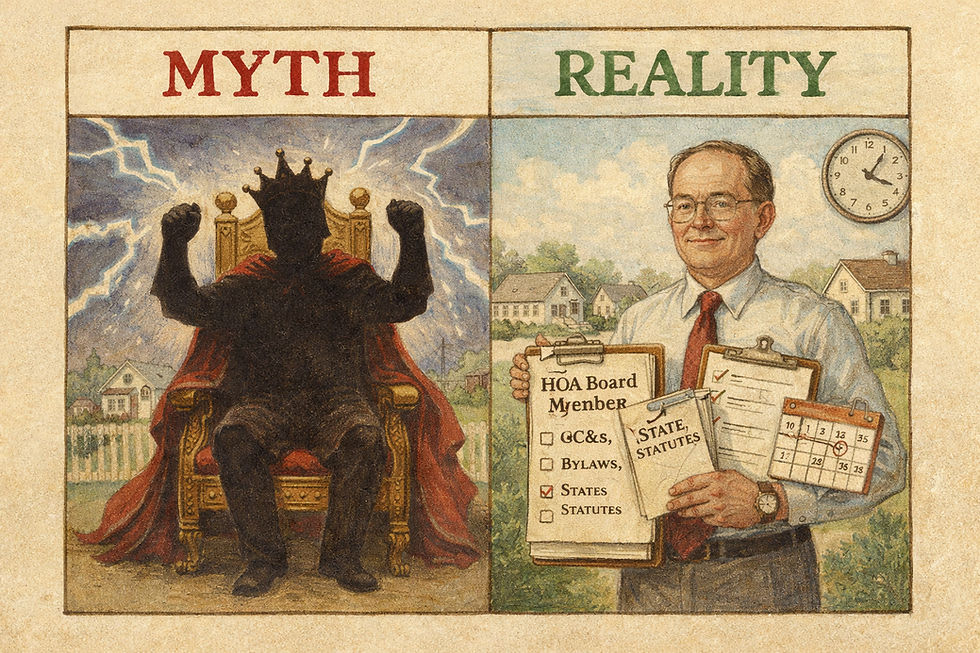
Myth 1: The Board Has Unlimited Power
The Myth: Many homeowners believe the board can create any rule it wants, dictate every aspect of community life, and make decisions based on personal preference. This perception paints the board as an all-powerful entity with unchecked authority.
The Reality: An HOA board's power is strictly limited by a hierarchy of governing documents and laws. These include federal and state laws, the community's Covenants, Conditions, and Restrictions (CC&Rs), bylaws, and any formally adopted rules and regulations. A board member's fiduciary duty requires them to act in the best interest of the community and in accordance with these documents, not on personal whims. They cannot create rules that contradict the CC&Rs or violate the law.
Fostering Trust and Transparency:
For Homeowners: Familiarize yourself with your community's governing documents. Knowing the rules and the procedures for changing them empowers you to participate effectively in community governance. If you believe a board decision is out of bounds, you can reference the specific document that limits their authority.
For Board Members: Proactively educate residents about the board's fiduciary duty and the documents that guide your decisions. When communicating a new policy or decision, cite the specific section of the governing documents that authorizes the board to act. This transparency demonstrates that you are operating within your defined powers.
Myth 2: Board Members Can Push Personal Agendas
The Myth: Homeowners sometimes suspect that board members use their position to benefit themselves or their friends, such as by approving their own architectural requests while denying others or by selectively enforcing rules.
The Reality: Board members are legally bound by a duty of loyalty to the association. This means they must avoid conflicts of interest and cannot use their position for personal gain. Most governing documents and state laws have specific procedures for handling conflicts of interest. For example, a board member typically must recuse themselves from any vote that directly affects their own property or financial interests. Pushing a personal agenda is a direct violation of their fiduciary responsibilities.
Fostering Trust and Transparency:
For Homeowners: Attend board meetings and observe how decisions are made. If you suspect a conflict of interest, you have the right to raise the issue respectfully, citing the relevant sections of your bylaws concerning board conduct.
For Board Members: Adopt and strictly follow a conflict of interest policy. Always disclose potential conflicts and recuse yourself from discussions and votes involving your personal interests. Documenting these recusals in the meeting minutes provides a clear record of the board's commitment to impartial governance.
Myth 3: The Board Can Levy Fines Without Oversight
The Myth: It can feel like the board can impose fines arbitrarily, without giving homeowners a fair chance to defend themselves. This leads to the perception that fines are a punitive tool used to intimidate residents.
The Reality: The board's ability to levy fines is governed by a strict due process. This process is outlined in state law and the community's governing documents. Typically, it includes providing written notice of the violation, citing the specific rule that was broken, giving the homeowner a reasonable amount of time to correct the issue (a "cure period"), and offering them the right to a formal hearing before the board. Fines cannot be issued without following these procedural steps.
Fostering Trust and Transparency:
For Homeowners: If you receive a violation notice, read it carefully. It should inform you of your right to a hearing. Take advantage of this opportunity to present your side of the story. Understand the formal process to ensure your rights are protected.
For Board Members: Create a formal, written enforcement policy and follow it consistently for every violation. Start with a courtesy notice before escalating to formal notices and fines. Ensure all communication clearly outlines the resident’s right to a hearing. This systematic approach demonstrates fairness and removes any perception of personal bias.
Myth 4: The Board Can Make Decisions in Secret
The Myth: When homeowners are unaware of board decisions until they are implemented, they may assume that important matters are being decided in secret meetings, intentionally excluding residents from the process.
The Reality: Most states have "sunshine laws" that require HOA board meetings to be open to all association members. Agendas must often be posted in advance, and homeowners have a right to attend and, in many cases, to speak during an open forum session. While boards may enter a closed or "executive" session to discuss sensitive topics such as pending litigation, contract negotiations, or disciplinary hearings, all final decisions and votes must be made in the open meeting.
Fostering Trust and Transparency:
For Homeowners: Make an effort to attend board meetings. If you cannot participate in the meeting, read the meeting minutes, which should be made available to all residents. Staying informed is the best way to understand how and why decisions are made.
For Board Members: Go beyond the legal minimum. Post meeting agendas well in advance and make minutes easily accessible on the community website or portal. Consider providing brief, plain-language summaries of key decisions in your community newsletter to keep everyone informed.
Myth 5: The Board Can Create New Rules Without Homeowner Input
The Myth: A common belief is that the board can invent and enforce new rules on a whim, fundamentally changing community life without any input from the people who have to live with the consequences.
The Reality: A board's rule-making authority has clear limits. While boards can typically adopt rules and regulations to clarify or implement the provisions of the CC&Rs, they cannot create rules that contradict or overstep those provisions. Amending the CC&Rs themselves—the foundational legal document for the community—almost always requires a vote of the entire membership, not just the board. Many governing documents also require the board to provide notice to homeowners before a new rule can take effect.
Fostering Trust and Transparency:
For Homeowners: Participate in the process. When the board proposes a new rule, provide constructive feedback during the designated comment period or at a board meeting. Your input can help shape more effective and reasonable policies.
For Board Members: Before adopting a new rule, solicit feedback from the community. Host a town hall meeting or send out a survey to gauge resident opinion. Explaining the problem the rule is intended to solve and showing that you have considered homeowner input builds support and leads to better, more widely accepted policies.
Conclusion: From Myth to Partnership
The perception of an all-powerful HOA board is a myth that damages community trust and creates an adversarial environment. In reality, a board’s authority is carefully defined and limited by law and governing documents. Their role is not to rule over their neighbors but to serve the community by upholding the standards that protect property values and ensure a harmonious living environment for everyone.
By understanding these limits and embracing transparency, both homeowners and board members can work together as partners. This collaborative approach leads to better decision-making, fewer disputes, and a stronger, more connected community.
Did I miss anything? Please let me know in the comments! Also, please subscribe to our blog to receive notifications when new articles are published.
At Don Asher Management, we've proudly served the Central Florida community for over 70 years. As a locally owned company with a strong understanding of the local market, we've cultivated strong relationships with regional and national contractors to deliver top-quality services. We're dedicated to meeting your property and HOA management needs with a personalized touch, combining our decades of experience and commitment to detail to provide unmatched service. We're confident in our ability to deliver exceptional services tailored just for you. Choose Don Asher Management—where personalized attention meets professional service.


Comments